
Related Questions:
– What is Machine Learning?
– What is Deep Learning? Discuss the key characteristics, working and applications of DL
Within the field of ‘Artificial Intelligence,’ there exists ‘Machine Learning,’ where we use computer algorithms to make predictions about previously unseen data using patterns and knowledge learned from existing data. Deep Learning is a subset of Machine Learning, and the technique that separates it from traditional Machine Learning is the focus on Neural Networks, systems inspired by the structure and function of the human brain. The term ‘deep’ alludes to the presence of multiple layers within these Neural Networks. Deep Learning is considered a more modern technology than many others within Machine Learning.
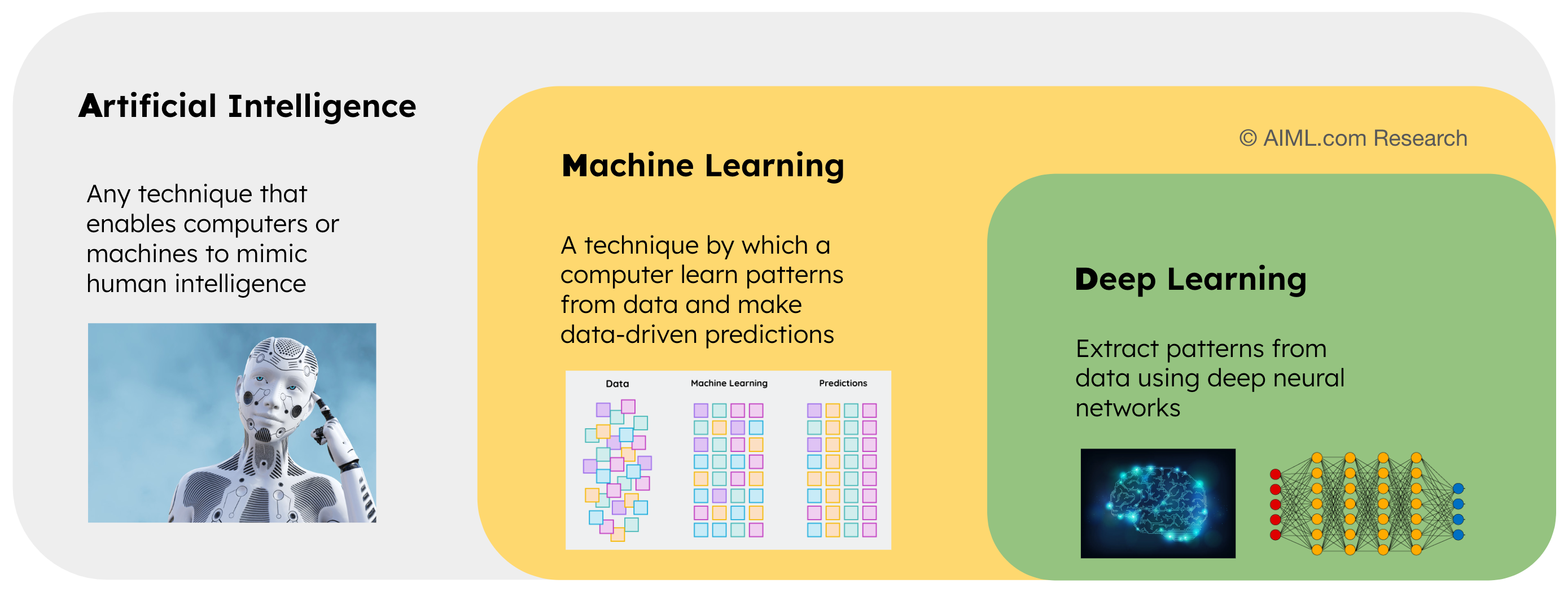
Title: Artificial Intelligence, Machine Learning and Deep Learning
Source: AIML.com Research
Part of the reason why Deep Learning is a newcomer is due to its reliance on high-end computer hardware, which has only become more feasible within the last twenty years. Unlike traditional Machine Learning, which often runs seamlessly on standard business computers, Deep Learning algorithms demand large amounts of data and substantially longer training times.
Deep Learning Algorithms
- Feedforward Neural Networks (FNN)
- Transformer Networks
- Recurrent Neural Networks(RNN)
- Long Short-Term Memory (LSTM)
- Convolutional Neural Networks (CNN)
- Generative Adversarial Networks (GANs)
- Autoencoders
Traditional Machine Learning Algorithms
- Linear Regression
- Logistic Regression
- Decision Trees
- Random Forest
- Gradient Boosting
- Support Vector Machines
- Naive Bayes Classifier
- Principal Component Analysis
- Gaussian Mixture Model
- Discriminant Analysis (LDA/QDA)
- K Nearest Neighbor (KNN)
10-point difference between Deep Learning and Traditional Machine Learning
[table id=22 /]
The choice between Deep Learning and Traditional Machine Learning depends on factors such as the nature of the problem, available data, computational resources, and the level of interpretability required. Both approaches have their strengths and weaknesses, making them suitable for different types of tasks. Deep learning is more suitable for complex problems with large amounts of data, while traditional machine learning is more suitable for simpler problems with limited data.
Video explanation (playlist)
- The first video on ‘Machine Learning vs Deep Learning’ by Levity discusses the key characteristics of the two concepts, their differences and how they fit into the larger AI landscape (Runtime: 8 mins)
- The second video by Krish Naik, explains the meaning of AI (Artificial Intelligence) and its sub-fields including ML (Machine Learning), DL (Deep Learning), and Data Science. The video substantiates each of these concepts with relevant examples (Runtime: 10 mins)
