
While the Empirical Rule provides bounds on the proportion of observations that fall within 1, 2, or 3 standard deviations from the mean of a normal distribution, Chebyshev’s Theorem provides a more general criteria for such bounds that applies to distributions besides just the normal.
It states that the maximum proportion of observations falling beyond k standard deviations (for k > 1) from the mean of a distribution is approximately  , meaning
 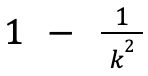 of the observations should fall within k standard deviations.
Whereas the Empirical Rule states that 95% of observations fall within 2 standard deviations of the mean, Chebyshev’s approximates at least 75%, and for 3 standard deviations away, the two theorems arrive at 99.7% and 89%, respectively.
While the proportion of observations within k standard deviations of the mean is smaller from Chebyshev’s than the Empirical Rule, the implication of having such a threshold for a wide class of distributions beyond just the Gaussian makes it a useful theorem in statistics.
